Maryanto
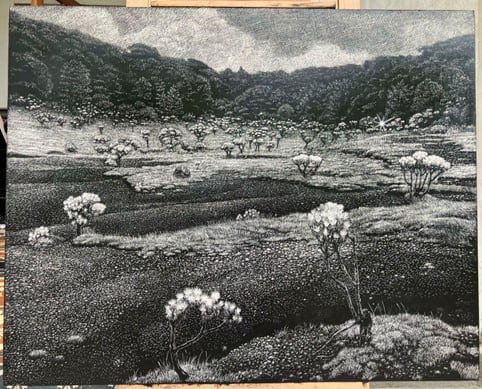
Humming, All the way to Rhino (MT. Pangrango), 2025
Scratching, acrylic on canvas
100 x 80 cm
Maryanto’s landscapes summon the voices of both the lost and the barely surviving, forcing us to reckon with truths long disregarded.
Maryanto (b. 1977) is an Indonesian artist who narrates the history of violence inflicted upon nature within socio-political structures through his landscapes, rendered in sharp, intricate strokes against a black background. Rather than depicting idyllic natural beauty, he captures the traces of places that have been destroyed and deliberately forgotten. As the landscapes buried beneath the blackened surface are gradually revealed by the grassland of densely packed, thin lines, we are confronted with stories that have disappeared yet refuse to be erased.
From colonial history to the present day, nature's story of degradation and destruction is a recurring narrative that continues to divide the land, bury oceans, and extinguish beings under a capitalist model of development. Through his work, Maryanto resurrects these lost landscapes. The nature that once thrived, now vanishing under the weight of extraction and devastation, lingers as a dark, unrecognizable mass—wounds and memories dismissed as unreal simply because they are unnoticed. Maryanto scrapes away this darkness with sharp tools to reveal once-obscured forests, trees, and blades of grass, much like how the world awakens as the shadows of dawn recede.
The perception of nature as a mere backdrop has long justified scenes of destruction as inevitable consequences of economic growth, allowing disappearance to be ignored. Maryanto fractures this indifference. He grasps at fading traces, exposes wounds that have remained unseen, and compels us to confront what we have overlooked. In Humming, All the Way to Rhino (2025), he captures the highlands of Pangrango, the former habitat of the critically endangered, relentlessly poached Javan rhinoceros, where only faint traces of their history remain. In The Shadow Behind Roots (2025), he reveals the shattered ecosystem of mangroves, exploited by the surrounding shrimp farms that connect their long waste pipes to the sea. In Breathe, Banyan Tree (2025), a massive banyan tree stands with its sprawling roots and towering trunk, echoing the legend of a sacred being that once healed a plague-stricken village with the water from Tamblingan Lake (Tamba, meaning medicine; Elingan, meaning memory or spiritual ability). From Mount Merapi, revered in Javanese mythology, comes the ancient warning: Ojo Adigang Adigung Adiguna—one must take only as much from nature as is truly needed. Yet, the consequences of ignoring this wisdom are clear to see: vanished forests, murky rivers, and a lost history barely clinging to existence.
Maryanto’s landscapes summon the voices of both the lost and the barely surviving, forcing us to reckon with truths long disregarded. We have witnessed the collapse of reason and order from many angles. How much have we erased, and how much have we chosen to forget?
From colonial history to the present day, nature's story of degradation and destruction is a recurring narrative that continues to divide the land, bury oceans, and extinguish beings under a capitalist model of development. Through his work, Maryanto resurrects these lost landscapes. The nature that once thrived, now vanishing under the weight of extraction and devastation, lingers as a dark, unrecognizable mass—wounds and memories dismissed as unreal simply because they are unnoticed. Maryanto scrapes away this darkness with sharp tools to reveal once-obscured forests, trees, and blades of grass, much like how the world awakens as the shadows of dawn recede.
The perception of nature as a mere backdrop has long justified scenes of destruction as inevitable consequences of economic growth, allowing disappearance to be ignored. Maryanto fractures this indifference. He grasps at fading traces, exposes wounds that have remained unseen, and compels us to confront what we have overlooked. In Humming, All the Way to Rhino (2025), he captures the highlands of Pangrango, the former habitat of the critically endangered, relentlessly poached Javan rhinoceros, where only faint traces of their history remain. In The Shadow Behind Roots (2025), he reveals the shattered ecosystem of mangroves, exploited by the surrounding shrimp farms that connect their long waste pipes to the sea. In Breathe, Banyan Tree (2025), a massive banyan tree stands with its sprawling roots and towering trunk, echoing the legend of a sacred being that once healed a plague-stricken village with the water from Tamblingan Lake (Tamba, meaning medicine; Elingan, meaning memory or spiritual ability). From Mount Merapi, revered in Javanese mythology, comes the ancient warning: Ojo Adigang Adigung Adiguna—one must take only as much from nature as is truly needed. Yet, the consequences of ignoring this wisdom are clear to see: vanished forests, murky rivers, and a lost history barely clinging to existence.
Maryanto’s landscapes summon the voices of both the lost and the barely surviving, forcing us to reckon with truths long disregarded. We have witnessed the collapse of reason and order from many angles. How much have we erased, and how much have we chosen to forget?
